Today is Mother's birthday, so I decided to bring these clippings out of the trunk of goodies. This would have been during her school days at Abbeville High. She was a cheerleader and the Centennial Queen of Henry County. I just hope she studied hard too! In photo two, she's pictured with the Governor of Alabama. (click the images to enlarge)
Click the map to view a part of the world that is of considerable interest to today's big players: Russia, China and the United States. Iran and India are also muscling their way into the picture. Britain's influence, on the other hand, is waning.
Throughout history Central Asia has been the scene of a contest that has been dubbed The Great Game. The original game was played by the British Empire and the Russian Empire. The Russians eventually gained control of Central Asia and this vast territory was an instrumental part of the Russian Empire and the Soviet Union. During World War II, the Germans were determined to seize Central Asia. What were they after? O-I-L. To get to the Baku, Azerbaijan oil fields, the German war machine had to go through Stalingrad, Russia. Stalingrad is now called Volgograd. See if you can find these cities on the map.
At this point, to understand the Battle of Stalingrad, I would encourage you to scroll down to the next two posts. When you have completed that, I would suggest viewing the following presentation by Steve LeVine, who recently authored The Oil and the Glory. In his presentation, Mr. LeVine discusses the quest for Central Asia's oil in the past and continued quest for it today. For further research, view Steve LeVine's blog by clicking here.
“The immediate cause of the German defeat was the unheard
folly of attacking the USSR,
while Britain
was still undefeated and America
was manifestly getting ready to fight.Mistakes of this magnitude can only be made, or at any rate they are
most likely to be made, in countries where public opinion has no power.So long as the common man can get a hearing,
such elementary rules as not fighting all your enemies simultaneously are less
likely to be violated.” - excerpt from a book I read
Here's just one example of what's not mentioned by McCain and others when discussing Georgia and Central Asia. Instead, we fall back on "Cold War logic" using simple answers and explanations to describe what's happening. There's a book that might interest you: The Great Game. It's about the chess board that is Central Asia and the major players historically, Great Britian and Russia, and the newcomers, the USA and China. At the forefront of the game is NOT human rights and democracy, but energy. And only the masses back home are carefully conditioned to think it's a moral game that's being played. It helps people sleep better, but is not reality. It's funny that we can point that out in other countries (the brainwashing) but we seldom view ourselves in that light.
World War II started 70 years ago when Germany launched an attack upon Poland. It was two years later, in 1941, when Operation Barbarossa (Hitler's surprise plan to attack the U.S.S.R.) began. In Russia today, the ensuing war with Germany and its allies is not referred to as World War II. It's known as the Great Patriotic War. To view a fascinating multi-media map and presentation of the Great Patriotic War, click this link.
To view Stalin's speech to his nation at a very pivotal point in the early stages of the war, see the following video.
The immediate cause of the German defeat was the unheard
folly of attacking the USSR,
while Britain
was still undefeated and America
was manifestly getting ready to fight.Mistakes of this magnitude can only be made, or at any rate they are
most likely to be made, in countries where public opinion has no power.So long as the common man can get a hearing,
such elementary rules as not fighting all your enemies simultaneously are less
likely to be violated. - excerpt from a book I read
Stalin is a realist; that is, in modern phrase he believes
in ‘power politics.’ And yet he lives in a world of make-believe.One must not think him insincere.Personally, he is no bluffer.He leaves the practice of buff to his
assistants, to whose words he does not pay very serious attention.When he comes forth to address the Soviet
citizens, he says what he conceives to the truth.One would search a long while to find
deliberate falsehood in his speeches.There is much which one must disagree, but there is no willful
deceit.He believes the fairy-tale which
he tells. - excerpt from a book I read
The Tsars were as absolute but their power not as great. - on Stalin, from a book I read
And, here's an e-mail from an American contact - a conservative, and bit of a history buff:
His question: Do the Russians recognize Stalin for the butcher that he was? He was just as bad, if not worse, than Hitler based on the # of his own people he killed. My reply:
It creates a dilemma for them. Yes, there's an outcry against what he did. However, many recognize him for the country's victory in WWII and industrial advancement. Overall, the crimes during that time were shocking and no sane person ignores this. Of course, here's a quote I found: "Stalin wouldn't have been able to commit all the atrocities he did were it not for the hundreds of thousands of little Stalins running around." Also, then, as today, our perception of Russia is often very distorted. We have to filter through our own propaganda, which is sometimes impossible to do. I do love this topic (anything WWII) and enjoy talking about it more than most things, even religion. A "friend" from Albany, GA has been living in Moscow the past five years. And he and I have gotten into debates over Russian history. He tends to downplay the admiration some Russians still have for the "best" of Stalin. And, in many instances, he has become an apologist for Russia today. For example, although he's very conservative politically and socially (in the American sense), he believes strongly in Putin and Russia's stances towards the US.
And way back in 2003, around the time of the US invasion of Iraq, I had been e-mailing a close family member. Once again Stalin's name was evoked. Here's part of my e-mail:
When you study the deeds of Stalin, you quickly realize that his ruthlessness was unmatched. (Saddam even studied Stalin's ways) Apparently, during the Second World War we had "no choice" but to side with Stalin. Also, Mark, you might find this interesting: The vast majority of people outside the US, at least the numbers I've talked with, including scores of Americas who have lived overseas, credit the USSR with defeating the Germans. To be honest, when I lived in Uzbekistan, I got challenged on this quite often because I carried the unquestioned belief that the US saved the world. Of course, that's not altogether true. One reason the Soviets took possession of the Eastern block nations and parts of Japan had to do with the upper hand they had on the other allies. Roosevelt, knowing that the Soviets were on the verge of capturing Berlin, had very little leverage in negotiating with Stalin. The irony in all this is that Stalin had millions of his own people and others put to death. In all, more people died at his hands than at Hitler's.
As for our own tactics at the end of World War II, many scholars and historians state that the British/American firebombing of Dresden and Tokyo were unnecessary and inhumane. Hundreds of thousands of civilians died. And, contrary to what we've been taught, a lot of the world thinks that those bombings, along with the horrific bombings of Hiroshima and Nagasaki, using the worst kind of WMDs, were primarily done to send a statement to Stalin. After capturing Berlin, the Soviets were heading towards Japan, and the US was anxious to quickly win the Pacific on its own. All of this laid the groundwork for the fall of China to the communists, the Korean War and the Vietnam War.
This is the name of a hill that was the epicenter of the bloodiest and most decisive battle of World War II. The battle took place in Stalingrad (today known as Volgograd) between 17 July 1942 and 2 February 1943. Atop this hill, which changed hands numerous times during the war, is "The Motherland Calls" statue. The statue is one of the highest in the world and is a part of an enormous memorial complex that was constructed in Volgograd in 1967. In the West, during the Cold War, very little was shared about this battle. I had only really known that we had landed at Normandy and liberated Europe from the Nazis. This proud moment in our history is actually a piece of a much larger pie. I learned this the hard way when I lived in Uzbekistan, when students asked me some tough questions. I didn't know nearly as much as I thought I did! I'm trying to make it for it now! The video I found (below) is truly priceless and is worth anyone's time. The first photo came from this travelogue, which also shows more photos and gives one person's perspective on modern-day Volgograd.
In an e-mail exchange several years ago with an American who knows way more about history than your typical US citizen, I gave him a bit of trivia:
me: Who is America's Caesar?
him: MacArthur
me: Who was perhaps the USSR's MacArthur, Eisenhower and Patton rolled into one?
him: I don't know any of their generals.
me: Zhukov
And then I sent him this follow-up:
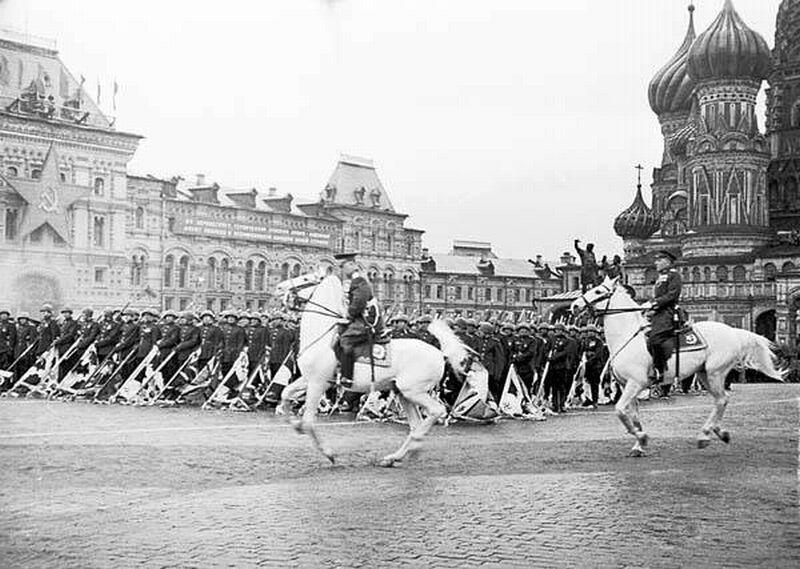
If you ever get a chance, watch movies about Russia's march on Berlin. It's shocking to many in other countries that we don't know much about Zhukov and even Russia's side of WWII. Like you, I didn't know his name. Only my recent interest brought this to my attention. If you can ever watch the YouTube footage of the Red Square parade at the end of the war, Zhukov rides the white horse. Whereas many Russians rightly remain conflicted about Stalin (crimes being one reason), General Zhukov is somebody they all are proud of. I would say the world owes him a lot. Stalingrad was the turning point of WWII.
Zhukov on horse, Victory Parade, Red Square 1945 - source
For other blog posts I have written on this subject, click the titles below:
The first image is of Dad showing a steer on the town square in Headland. I will have to ask him to help scrounge up an approximate date the photo was taken. The second one is of me and my prized steer. This steer won Grand Champion in Henry County, placed fairly highly in the Tri-State Show and then was auctioned off to Hardees and some other business. As these photos attest, often activities are passed down through the families. My brother Miles, stepbrother Luke and I got started showing steers as early as 1980 or 1981. Dad provided the steer and we paid for the feed. There's no telling how many hours we - well, perhaps mostly Dad - spent "breaking" and grooming these fine beasts. In the end, when the last show was complete, we'd always have quite a bit of spending money. Usually by then, my income was parlayed into another hobby: baseball card collecting. Incidentally, baseball card collecting was another hobby Dad introduced to my brother and me. Dad had a collection when he a boy and he saw to it that we got our first set of cards. In fact, the first set he gave us was a 1979 Topps set, ordered from Reneta Glasgow. We were sitting around the dinner table at my grandparents' house when Dad gave the new set to us. I remember that box of cards, and where Dad was sitting at the breakfast table when he gave it to us. That hobby - baseball card collecting -became an obsession Miles and I pursued for many years!
Thanks, Allen !
My steer won Reserve Grand Champion in Henry County. I was either in the 7th or 8th grade. After winning with this steer, Daddy and I decided to go into the cattle business so we went to Mr. Jack Bridges and purchased 10 Registered Black Angus heifers and grew them to breeding age. The next year we purchased a bull from Rocky Creek farm in Ashford, owned by W.A.Womack and his son, Billy. Their farm was considered one of the top Angus farms in the U.S., not just Alabama. This was the beginning of M & M Farms (Major & Mark).
The year above would have been 1957 or 58.
Love,
Dad
My dad grew up around horses, which explains his rekindled love affair with them later in life. Dad also showed steers in livestock shows, and passed this tradition on to his sons Miles and me, and stepson Luke. Cousins Jeff and Will also showed steers once or twice, and Dad helped them too. In the video above, towards the end, there's a short video of Dad with his Black Angus show steer (very likely the one in the top photo).
April 19, 1961
cousin Sid Brannon on left, Major W. Espy, Sr. in background
Wiregrass Farmer, April 27, 1961
Dad, likely in high school.
These steers were halter-broken, walked, clipped, washed, dried, combed, gelled, shown, auctioned off, slaughtered, eaten.
After the year of bonding with our steers, which we named by the way, we had the shows and then auction. The auction started later at night, but all the kids stayed around to walk their steers through the auction ring while people/business were bidding on them. Once your steer was sold, you then handed the halter lead to another person who would then lead the steer through a doorway to an area where they would be grouped together with other steers destined to go to the same "packaging plant." My dad would always like to stay for a little more of the auction, often buying one or two steers himself. While he was doing that, I would wander the livestock barn and find my steer in its holding pen. I would RUB its head, talk to it and say goodbye.
One year, the morning after the show and auction, I jumped in the car with my mom, who was taking me to school. I was probably in the 5th gade. A Kenny Rogers song, Through the Years, came on the radio. It made me think of my steer. I felt very sad. I cried a bit. I had his ear tag in my jeans pocket and pulled it out and looked at it.
Girls and boys alike were proud participants in the shows. Some parents were fanatics about traning their steers and having the best equipment to make sure their child's steer had the best chance to win. Others, like my dad were more laid-back. It was about the experience more than anything. So, you had several years of this. And for many of the parents, they were doing what they had done when they were young. What's interesting, out of my nieces and nephews (five total), none showed steers. My oldest niece didn't want to do it b/c she didn't want to auction off her steer at the end.


 Click the map to view a part of the world that is of considerable interest to today's big players: Russia, China and the United States. Iran and India are also muscling their way into the picture. Britain's influence, on the other hand, is waning.